“You no longer have any restrictions, but you will certainly have some limitations. What those are, and how you manage them, is for you to figure out.”
These words from my orthopedic surgeon run through my mind daily. My ankle is still fucked. It will never be 100% again. The question is just how much I will regain, and how long that will take. It is still quite weak. It has limited flexibility. It hurts if quickly come down on it with a lot of force (e.g. running, “running out” of a trick, landing Primo, etc.). Stairs are difficult.
What does this mean for skateboarding?
The short version is that;
(1) There are a lot of tricks I can no longer do at all,
(2) There are a lot of basic tricks that are really sketchy/scary to do, and
(3) My ability to do “controlled falling” is not what it used to be.
I can not skate transition over 2’ high, because I can’t run out of bail with that much force coming down on my ankle, and it isn’t reasonable to think I’d be able to just knee slide out of everything. Nollies, switch ollies, etc., those are gone. Ankle just isn’t strong enough for them. Even regular ollies are weird, because my ankle does not have the fine motor skills anymore to guide the board with exact precision. Right now I am mostly just doing stall tricks on curbs/low ledges, and slappies, to get the muscle (new) memory going. Small transition is just basic lip tricks. Independent of my ankle, I have not seriously skated in nine months. The rest of my body also has to become reacquainted to the demands of skateboarding. So, there is a lot going on right now.
GOALS & EXPECTATIONS
I realize that I will probably never again skate like I once could. I return to skating with no expectations from before. That said, my goal is to skate at a level that is meaningful to me. Carving around a parking lot, with no tricks, is not going to cut it. So, the question becomes what is a “meaningful level”? As of now, my goals/hopes are:
-Basic curb tricks (slides, grinds, etc.)
-Basic tricks on very small transition (2’ and under)
-Carve around in bigger bowls
If I can get to that level, with some degree of consistency, I’ll be happy. And I feel fairly confident I will be able to—it just may take awhile. A dream situation would be to skate a 4’ mini ramp again.
STRETCHING / WARMING UP
My entire body, not just my ankle, needs to get in shape again. I have become really stiff. I need to stretch on a daily basis not just for ankle physical therapy, but to help with everything else, too. Before skating I now have to spend at least 5-8 min stretching out. This is not only to help get my ankle loose, but to help prevent strains, pulls, tears, etc. to other parts of my body.
PADS
There is a metal plate and screw in my lower leg/ankle. Even slight taps to that area cause tremendous pain. The scar tissue/incision area is really sensitive, and when the plate gets hit…game over. And as any skateboarder knows, getting hit in the ankle with your board (even lightly) is a very, very, very common thing. So, I need to add some protection to that area. I got a kid’s soccer shin pad, which fits right over the area and protects it nicely.
I cannot fully “run out” of bails. This causes me to fall sometimes on occasions that I never would have fallen before. My ankle sometimes betrays me, and causes me to collapse in pain (e.g. during a failed “run out,” or if I bail and land on foot with too much force/at an angle, etc.).
Because my ankle is weak, slow, and stiff right now, I no longer have the same capacity to do “controlled falling” (to the extent I ever did before). We all know that “controlled falling” is an essential skill to skateboarding. Sometimes I go down in very awkward ways now.
Then there is the “mental game.” I will be 100% honest—a lot of skateboarding scares me right now. Fear of reinjury to my ankle. Fear of serious injury to some other part of my body because I can’t properly fall because of my ankle. Reinjury Anxiety is a REAL thing.
So, the obvious conclusion here is that for the near future I absolutely should be wearing knee/elbow pads anytime a “run out” might be required. Grinds, slides, transition, etc. Yet, I haven’t always done so. Somewhere in my head I hear this voice saying, “You don’t need pads to skate a curb or a 2’ tall quarter-pipe.” Truth is, right now I actually do. Maybe there is also some level of shame in there, too? I’m not sure what it is all about. I just know what logic tells me to do verses what I actually do. Sometimes there is a gap between those two. I’m working on that.
Sunday, March 29, 2020

Thursday, March 19, 2020
A Quck Recovery Update
It’s been awhile since I updated about recovery, skating, hockey, etc. With the world gripped by Corona Virus, looks like I’ve got some time on my hands.
MEDICALLY
On December 20th, 2019 I had another surgery. Some hardware was removed from my ankle, and they scrapped out some internal scar tissue. Hopes were this would make my ankle more flexible and functional. Up to this point, things were not progressing as fast as anyone would have hoped. I was cleared to skate again (within reason) on Feb 19th, 2020. Orthopedic surgeon made a very poignant comment. “You no longer have any restrictions, but you will certainly have limitations. What those are, and how you manage them, is up to you to find out.” That is actually good life advice.
ACTIVITY
My ankle is still fucked-up. Maybe better than before the second surgery, but nowhere near what it was before the break. It will probably never be 100% again. The question remains just how much I will get back, and how long that will take. I am skateboarding again (very low impact, and no tranny over 2’ high). I am back on the hockey (in-line) skates, but haven’t been back on the ice yet. For short distances, I can “run” (light jog) in a very fucked-up way. In the near future I will make another post which is specifically about what I can/cannot do with skateboarding at this point.
MENTALLY
First, I still have a lot of “reinjury anxiety.” It’s a real thing. That will take quite some time to go away (if it ever fully does). Second, I am very happy to be skating again, even at limited capacity.
MEDICALLY
On December 20th, 2019 I had another surgery. Some hardware was removed from my ankle, and they scrapped out some internal scar tissue. Hopes were this would make my ankle more flexible and functional. Up to this point, things were not progressing as fast as anyone would have hoped. I was cleared to skate again (within reason) on Feb 19th, 2020. Orthopedic surgeon made a very poignant comment. “You no longer have any restrictions, but you will certainly have limitations. What those are, and how you manage them, is up to you to find out.” That is actually good life advice.
ACTIVITY
My ankle is still fucked-up. Maybe better than before the second surgery, but nowhere near what it was before the break. It will probably never be 100% again. The question remains just how much I will get back, and how long that will take. I am skateboarding again (very low impact, and no tranny over 2’ high). I am back on the hockey (in-line) skates, but haven’t been back on the ice yet. For short distances, I can “run” (light jog) in a very fucked-up way. In the near future I will make another post which is specifically about what I can/cannot do with skateboarding at this point.
MENTALLY
First, I still have a lot of “reinjury anxiety.” It’s a real thing. That will take quite some time to go away (if it ever fully does). Second, I am very happy to be skating again, even at limited capacity.
Wednesday, January 1, 2020
2019: Thank God It Is Over
2019 was one of the hardest years of my life. I supposed I should take a moment to reflect on it. It was marred with emotional, physical, and existential pain. A few of the “highlights” include my mom having another back surgery, a friend’s father dying, a bad kidney stone (and subsequent surgery to remove it), my car died (for good), a second major surgery for my mom (hip replacement), a pet put down, a friend’s sister committed suicide, some problems at work, and taking care of my increasingly elderly and disabled parents alone. If that wasn’t enough, I broke my leg in late May. It didn’t heal all that well, and I had a second surgery on 12/20 to remove hardware and scrape out internal scare tissue (hopefully increase its flexibility). I will be in a “boot” until at least Jan 6th. It remains to be seen what the outcome will be. The entire year has been a very humbling experience. The biggest sources of stress were, and remain, (1), will I be able to meaningfully skateboard again (and if not, then what becomes of my life), (2) general concern for my parents, (3) anxiety about my own future. It’s certainly been a bad year.
That said, it has not been all bad. In February I started the process of learning to play ice hockey. Granted, I hit a huge speed bump with the broken leg. Hockey was also one of the things that helped get me through the “broken” period. I was able to start dry land hockey stuff long before I could even hope of stepping on a skateboard again. So, I am really fortunate that I had that as an outlet. It’s been bittersweet, however. I was not able to take two different “Learn to Play” classes because of the injury. I should be much further along in this process than I am already.
The two best things that happened in 2019 were that (1) I had some great friends who helped keep me occupied, and positive during the worst of the “crippled” period, and (2) I spent a lot of time with my parents (for better or worse). I am very grateful for those two things.
I leave 2019 behind, not with any resentment or ill-will, but with a greater sense of gratitude and humility for daily life than I ever had before. I have a few hopes for 2020. They are:
(1) Ride my skateboard and bike as much as I can
(2) Continue learning hockey
(3) Develop an even deeper understanding of what it means to find salvation in daily life
(4) Spend quality time with friends and family
I wish all of you a healthy, happy, and meaningful New Year.
That said, it has not been all bad. In February I started the process of learning to play ice hockey. Granted, I hit a huge speed bump with the broken leg. Hockey was also one of the things that helped get me through the “broken” period. I was able to start dry land hockey stuff long before I could even hope of stepping on a skateboard again. So, I am really fortunate that I had that as an outlet. It’s been bittersweet, however. I was not able to take two different “Learn to Play” classes because of the injury. I should be much further along in this process than I am already.
The two best things that happened in 2019 were that (1) I had some great friends who helped keep me occupied, and positive during the worst of the “crippled” period, and (2) I spent a lot of time with my parents (for better or worse). I am very grateful for those two things.
I leave 2019 behind, not with any resentment or ill-will, but with a greater sense of gratitude and humility for daily life than I ever had before. I have a few hopes for 2020. They are:
(1) Ride my skateboard and bike as much as I can
(2) Continue learning hockey
(3) Develop an even deeper understanding of what it means to find salvation in daily life
(4) Spend quality time with friends and family
I wish all of you a healthy, happy, and meaningful New Year.
Tuesday, December 17, 2019
Welcome Back: Starting Up Again After a Long Break, Part II.
PART II: EQUIPMENT
This is the second installment of a four part series on returning to skateboarding after a long break. The first section covers a mind/body “reality check,” and what you should, and should not, expect upon your return. Also covered in that section is common injuries with returning skaters, and how to minimize them. If you have not read that information yet, you are encouraged to do so. That post can be found here.
This is the second section, which covers equipment in case you’ve been out of the industry-loop for a while. Part Three covers navigating the skateboard social world, as a “returning” skater, so you don’t end up look like a total turboclown (hint: no one cares how good you used to be). I recently added Part 4, as an epilogue to this series, which deals with skate-related anxiety.
While this is a long post, it intended only to be a “quick” and general overview of equipment. It is certainly not exhaustive. I’m sure that others may have different views and perspectives on everything I cover here. Just remember this material is only intended to be a starting point, and it is not dogma. Only you can figure out what works best for you. I am just trying to help get the ball rolling. That said, on we go…
Decks
The most common question when returning to skating after a long break is, “What kind of deck should I get?” It’s a great question, and the truth is you have more options now than at any point in skateboard history. If you want a 1983 Madrid Explosion reissue, no problem. A late 1980s H-Street deck? Yup. That’s reissued, too. Early 1990s football shaped decks are also available, along with modern “shaped” decks. And of course, the now standard “popsicle” is widely available. If you want it, you can get it. The amount of variety available now is really astonishing. There is literally something for everyone, and that is how it should be.
So, what should you get? The short answer is get whatever resonates with you. That said, what worked for you as younger skater might not work as well for you now. The shape and size of boards evolved for a reason; ease of functionality. You may have a much easier time honing your ollie again on a modern deck (lighter, large upturned nose and shorter wheelbase) than with an old-school deck (super heavy, no nose, and longer wheelbase). The upturned nose allows your front foot scoop the board up, and the shorter wheelbase helps with more effective vertical pop. But what if you don’t care about big ollies, or just really want an old-school reissue for nostalgia purposes? Then without any hesitation, you should unquestionably be riding that reissue. A friend of mine who religiously rode shaped boards later gave a popsicle a try. He wrote a great article on the two, and what advantages and disadvantages each has. It is absolutely worth your time to read. That article can be found here: Popsicles vs. Shaped Decks. If you don't want a modern popsicle deck, no problem. But again, equipment evolved for a (damn good) reason. If you are looking for some functionality, but don't want a popsicle, I would strongly advise taking a hard look at modern shaped boards. These retain some of the old-school feel, with modern advances.
So, the best path forward is to find a local shop, and stand on as many boards as you can. Stand on everything, 1980s reissues to popsicle-shaped decks. In doing so, start to develop an idea of what feels good under your feet. Most all, just figure out what seems like something you’d have the most fun with (but a word of caution comes with that; Reissues often seem like the would be fun. However, people often get on them and realize, "Yeah. These things are horrible skateboards. I'm so glad equipment evolved"). Keep in mind that not all skate shops are the same. Some carry many different board styles. Others cater to only “popsicle” shaped boards. Tactics Skate Shop has a great web site and inventories of all kinds of decks. Browsing their stock can give you an idea about what options are out there.
Deck Dimensions: If you stopped skating in the 1980s, today most standard sized boards will seem small to you. Conversely, if you stopped in the early/mid 1990s, boards will now seem big to you. In contemporary times, the most common dimensions are:
Width: 8.0” – 8.75”
Length: 31.8” – 32.4”
Wheelbase: 14” – 14.75”
Tail: 6.25” – 6.5”
Nose: 6.75” – 7.25”
Remember that these numbers are only the average, typical sizes. You can get boards that are much smaller, or much larger, in both popsicle and shaped decks. Again, stand on as many boards as you can, and just see what “feels right.”
Small Batch Brands: Everything I’ve said so far is about mass produced skateboard decks. There are other options. There are now a plethora of smaller, local, hand-made, brands available. You will have to connect with your local scene to tap these options.
Grip Tape: The most common grip tape companies are Jessup, MOB, and Grizzly. Jessup is a little less “grippy” than MOB (which can be a too coarse for some people). However, Jessup is known to peel-up a bit on the sides after long use/wear. Any local shop, or on-line store, can put tape on for you if you don’t want to do it yourself.
Trucks & Bushings
Trucks: The big four names in trucks these days are Independent, Thunder, Venture, and Ace. There are other options (Tracker and Gullwing still exist!), but the "Big Four" are the most common. The basic rule is to match the width of your trucks to the width of your deck. While you are absolutely free to ride trucks wider, or narrower, than your deck, matching-up width is a great place to start. Each company has their own truck size charts that can be viewed on their respective web sites. Each has their own different truck models, too (e.g. standards, hollow axle/king pin, titantiums, etc). Personally, I would say go with a set of Independent forged trucks if you're getting back into things. Why? Because you will never go wrong with Indy. Ace and Thunder are also very popular trucks. Ace trucks ride looser than Indys. Thunders ride tighter. Indy is a good happy medium to get you rolling again. Why the forged Indys? Again, aiming for the happy medium. Standard Indys are 55mm tall. These are among the tallest trucks on the market. Most trucks now range between 51mm and 53mm tall. Indy forged trucks are 53mm tall, so again, that happy medium. But what if you are setting up larger wheels? No problem. Just add a small riser pad. You can always make lower trucks taller (with a riser), but you can never make taller trucks lower. Plus, the forged Indys have a stronger baseplate than the standard (non-forged) ones. (NOTE: I would advise staying away from the Indy "Mids" (inverted kingpin, 52mm tall) which were released in 2021. I'll update why in the near future).
Bushings: You may be a bit, well, "larger" than you were when you last skated. This will impact how your trucks turn. A 200 pound adult male is going to put a lot more pressure on truck bushing than a 140 pound teenager. Where am I going with this? Your trucks might feel a lot looser than you want them to be. Part of this can be directly attributed to increased weight. But fear not. If you find your trucks are too loose, you can get harder bushings to replace the stock ones with. Usually bushing comes in two "shapes." One is a conical shape (e.g. the bottom one tapers) and the other is a standard cylinder shape (e.g. there is NO taper). The standard cylinder ones ride a tad "tighter" than their conical counterparts of the same hardness. It was on explained to me that, "conical bushings allow more turning range, while barrel bushing provide stability." This seems to make some sense.
Most trucks come with stock bushings that are in the 90a-92a range. After market bushing can go up to 100a hardness. If you decide to swap out your bushings, just make sure you get ones that are compatible with your trucks (not all bushing are interchangeable). Last, you may hear a lot about Bones Bushings. They are indeed great, take very, very little time to break-in, and give a very smooth turn. Note however, they are known for "blowing out" after awhile. They also blowout from the inside, so it can be difficult to visually tell they are toast. If you keep tightening them down, but they don't seem to get any tighter, that means they have blown out. Despite this problem, they do indeed have a large following because of how good they otherwise perform. One last note on Bones bushings--their "hard" bushing is a 96a (which is actually a mid-range hardness), and it rides MUCH "softer/looser" than almost all other 96a bushings. The "medium" Bones bushings come in at 91a, which actually on "soft" end of things, and they ride much softer than any other 91a bushing. Last the soft Bones bushing are 81a, which is incredibly soft. I have never met anyone who has those on their skateboard. Personally, I would avoid those.
Three last notes on bushings:
First, if you skated in the late 1980s or early 1990s, then you remember how bad Indy stock bushing were. Well, a lot has changed in the last 30 years. However, the folklore around Indy bushings unfortunately remains. In the present day, Indy stock bushings are great. Moreover, if the stock ones are too soft/hard for you, Indy makes a ton of after-market bush in a whole range of hardnesses, in both cylinder and conical shapes.
Second, Ace trucks ride very "loose." They come stock with quite soft bushings. Ace bushing are not standard sizes, meaning they can be difficult to swap-out without changing the intended turn geometry of the trucks. Ace makes harder after-market bushings for people who may think the Ace stock bushings are too soft/lose, but even the "harder" Ace bushings are still quite soft. If do not like the feel of really loose trucks, avoid Ace.
Third, and this one is important. When you are riding a new set of trucks, with new bushings, the bushing will often feel a bit "mushy" and soft at first (e.g. your trucks will ride "loose"). Bushings stiffen-up as they break-in. So, avoid really cranking down the kingpin nut if they are too loose when you first get on them. Yes, you can tighten it, a little, but don't go crazy. Instead, just keep skating. They will break-in, and once they do, they will start to ride a bit stiffer (stock Indy bushings take me about 20-30 min for this to happen). If you crank down that kingpin nut before the bushings are really broken in, you run a much greater chance of blowing-out the bushing. Also, if your kingpin nut is showing a lot of kingpin threads sticking out over the top of the nut (e.g. you've got the nut cranked down pretty hard to tighten your trucks up), it means you need harder bushings. Your kingpin nut should, more or less, sit close to flush with the top of the kingpin bolt.
Wheels
In the 1980s wheels averaged around 60mm in size, and about a 95a hardness. In the early 1990s the size dropped down to sub-40mm, and hardness went up to 103a. Things have since stabilized. Standard size wheels now range 51-54mm for street, and 55mm-58mm for bigger transition. Again, all of this is somewhat subjective. Like decks, if you want reissue Rat Bones or Slimeballs, you can get them. Most modern wheels are 99a or 101a. There are, however, many companies that make softer wheels, even down 85a. Again, if you want it, you can get it.
For most of this post I will steer clear of advocating for specific brands or products, because I want people to make up their own minds about what works best for them. I will, however, make a few exceptions to that rule. Wheels is one of those expectations.
In my humble opinion, the best wheels made today are Spitfire Formula Four wheels. There are few reasons why I think they are the best. First, they are among the most flat-spot resistant wheels on the market. There are several YouTube clips of people TRYING to flat-spot them with long power slides, and they are unable to do it. Yes, ALL wheels will go out-of-round with time and use, but Formula Four Spitfires seem to be far more durable than anything else. The second reason I am big fan of Spitfires is that they come in a lot of sizes and shapes. The performance of wheel shape is a subjective thing. Which is the best? That is your call. A wheel with a rounder edge will roll into and out of grinds easier, and will initiate power slides easier than a more squared-off wheel. Conversely, a squared-off edge will “lock-in” to (some) grinds better. Spitfire makes a variety of different shapes to choose from. This video does a GREAT job of explaining all the technical difference between rounder edged wheels and square edged wheels. I would strongly advise you watch it.
IMPORTANT: DO NOT buy “regular” Spitfire wheels. They suck, and flatspot quickly. ONLY BUY THE FORMULA FOUR Spitfires.
Other popular wheel companies are Bones (Powell), Speedlab, Mini Logo, Ricta, Slimeballs, and OJs. Note that some of Bones wheels are graded on a different durometer scale (the B-Scale), and might be a bit confusing at first. Their web site will explain it.
A Note About Ratios: My friend Bob made this remark in the
comment section below. It is so important that I am adding it to the
main body of this post. I can't believe I over looked this. Bob's
comments are spot on;
"If you are going to ride a modern board, set it up as a 100% modern
board. Setting up a modern street deck (popsicle) with massive old school
wheels really doesn't work. The proportions aren't right. And
proportions are everything." Following Bob's comments, here is someone's account
of an epiphany they had about their ratios being way off. Dude's board
was set-up in a way that not only negatively impacting his skating, but
it also having adverse effects on his body (board height was aggravating an Achilles problems). Dude changed his equipment, and things got much better, almost instantly.
His story is well worth your time to read, because it illuminates and
important point about "proper" ratios with your set-up.
Bearings
Bearings are another place where I will advocate for a specific product. But first, a note about bearing technology. Historically bearings contain seven 5/32 inch balls within each bearing ring. Powell came up with a new system. They now produce a bearing that has six, larger, 3/16 inch balls instead of the smaller seven-ball version. In the six-ball version, the balls are 20% larger, and thus roll fewer times to go the same distance. The six-ball version accelerate quicker, have a higher top speed/roll faster, and resist the impact of landings better than the standard seven-ball design. The six-ball version is most likely the future for bearings. So, what should you get? If you want to go the six-ball route, there are two options. First, is Bones Big Balls Reds. These are the “lower price point” version. They run about $25 bucks for a set. Second is Bones Super Swiss Six. These, IMHO, are the best bearings on the market. They run about $60 a set. Yeah, they are more expensive, but they are absolutely worth it. If you don’t want to go the six-ball route, Powell still makes standard seven-ball versions. Those are the Bones Red ($18 a set), Super Reds ($30 set), and Bones Swiss ($55 a set). Remember that you get what you pay for, and half the fun of skateboarding is the ability to roll. Bearings are what makes that happen. Choose wisely. There are number of other decent bearings out there, but you will never go wrong with Powell/Bones.
IMPORTANT: Never buy bearings (esp. Bones bearings) from Amazon/eBay. Never. There are many counterfeit, fake, cheaply made versions of Bones bearings out there. Powell is aware of this, and has even issued some public statements about the issue. If you are going to buy Bones bearings ONLY get them from a reputable skate shop.
CLEAN YOUR BALLS: Bones bearings can easily be cleaned, provided that you so according to manufacture specs. You should do this when needed, esp., if you get one of the more expensive versions. Cleaning them will make them last longer, and keep you rolling at top speed with minimal effort.
Shoes
Ok, shoes. This topic could be its own post. Hell, it could be its own blog. Shoes are a huge market, and there are many, many options. Shoes are actually a somewhat controversial topic. Some very Big Name Sporting Companies have developed a strong presence in skateboarding. Nike. Adidas. New Balance. Converse. Etc. And as I am sure you know, Vans is no longer a tiny company that takes out tiny ¼ page ads in back of skate magazines. They now have retail outlet stores at almost every large mall in America. Things have really changed. Before I get into specific brands, there are two basic models of skate shoes. One is “vulcanized.” The other is “cupsole.” These terms refer to the way the sole of the shoe is manufactured. They feel, and skate, radically different from each other. Vulcanized give you much more “board feel” but can also provide a lot less “cushion” for your feet. Cupsoles are the exact opposite. Cupsoles can make it more difficult to “feel” the board, but they provide a lot more impact cushion. I’ll go an extreme to illuminate the point: vulcanized shoes are like skating in socks, while cupsoles are like skating in moonboots. What to get? Go somewhere and try on lots of shoes (and stand on a deck if you can), and see what feels best to you. Usually people fall squarely into one these camps (vulcs v. cups) and despise the other. It is very rare to find someone who likes both vulcanized and cupsole shoes.
VANS: Vans have been around forever. They have supported skateboarding since Day One. Their shoes have changed a bit over the years, but mostly remain the same. The vast majority of Vans shoes are vulcanized. Some older skaters say that their feet and knees will no longer allow them to skate in Vans. Usually that is because they are wearing the "classic" Vans. Note that Vans has two lines of shoes, Classic and Skate. The "classics" are designed for people that hang out in the food court at the mall. The "Skate" version is designed for, well, skateboarding. I often see people rail against Vans and complain that their feet hurt after skating...only to realize they wear the Classics and not the Skate version. To this end, however, there are some skaters who prefer the Classics...but not many. The "pop cush" insoles that come with the Skate version is top-notch, and can do a lot to help those old feet and knees. That said, some may need the added cushioning of a cupsole shoe.
NIKE / ADIDAS / NEW BALANCE / CONVERSE: These are all big name sports companies that have deep pockets for research and development department. And it shows. Contrary to Vans, some older skaters claim that Nike (or other Big Name company) shoes are the only reason they can KEEP skateboarding. These shoes can be surprisingly expensive. Moreover, all of these companies can be somewhat controversial in skateboarding. Some people are really against the idea of "outsiders" trying to play the "carpetbagger" role. I will not take any sides on that issue here, other than to point out that such controversy exsits.
OTHER BRANDS: I’ll be honest, I cannot speak from too much personal experience on other brands. I skate in Vans. I have tried other brands (inc. Adidas), and I just didn’t like the board feel, the fit, or the looks. There a ton of other brands, and each offer lots of different shoes. Other big companies are Emerica, Etnies, and eS (all owned by same company), DC, Fallen, Lakai, and Supra. If you want any more detailed reviews of these, check out the SLAP Forum. UPDATE: Circa late 2024 there are some big "corporate" changes to some these companies (esp. Lakai), and it's not clear what their future is, if at all.
Accessories
Ok, maybe I lied. I said you could get anything you want these days. Well, that may not be true. I am not sure if you can get skid plates anymore (aside from ones for freestyle boards) or nose bones for that matter. That said, rails, coopers, and even lappers are still available! Moreover, side rails have made somewhat of a comeback. While they never totally went away for transitions skaters, for a long time you never saw side rails used by street skaters. That is no longer true. While they are not the standard for street skating, you absolutely see some street skaters using them again. In some contexts rails have a huge advantage, and they can be really fun to play around with. What are those huge advantages? Watch this clip and you will see it all explained in great detail.
Pads, Helmets, Etc.
I talked a bit about pads in part one of this series. I have also written about pads elsewhere on this blog (this one is definitely worth your time to read). One thing is quite true with pads, you get what you pay for. If you are seriously looking for protection, drop the money for it. If something seems expensive, ask yourself, is the ability to walk worth $100? I recently wrote a much more extensive safety gear Buyer's Guide, which can be found here. That Buyer's Guide is a deep-dive into pads, so I will let that post do the talking, and not say much else about pads here.
On to the Next
So, that about covers it for equipment. Remember that skateboarding is supposed to be fun, and it has no rules. With those considerations, when putting together a new board, go for what you are going to have the most fun with, but remember that equipment evolved for a reason (e.g. don't unduly let nostalgia for past hinder your ability/equipment choices in the present). That said, follow your own path to happiness, no matter what deck, truck, or wheel that may be. Your Stoke does not have to meet anyone else's standards.
Part Three covers navigating the skate shop, the skate park, and skateboard social media without making a fool of yourself.
Tuesday, November 26, 2019
Welcome Back: Starting-Up Again After a Long Break
So, you started skating again (or want to) after a long break? Awesome! First, and foremost, welcome back! This is a great time to get back into skateboarding. Our golden age is happening now. There are parks and DIY builds everywhere, any type of equipment you might want is available (not true in the past), and there are plenty of ways to get connected with other (older) skaters. Moreover, if you stick with it, you will have more fun skateboarding now than you ever did before. I promise you that. However, before you get totally up and running again, there are a few speed bumps along the way that need to be addressed, and that is exactly what we are here to do.


Street Skating: If you are pure street skating, pads are not as “essential” as they are on transition. That said, contrary to what many claim, you actually can “knee slide” on street (Natas, and a 10-year-old, will show you how). I don’t wear knee pads on street (yet). I am sure it will eventually happen some day, but I always wear an elbow pad on my forward elbow, even if just skating a curb. Falling on your hands sucks, and can also lead to a sprained/broken wrist (remember, we break easier now). When I fall, I tuck my arm in, and let the elbow pad take the brunt of the impact. No cut hands, no wrist injuries, no swelbow (and to really drive the point home, everything takes longer to heal with age). A friend of mine, and good skater, shattered his elbow two weeks ago. Slipped out on something, and came straight down on his elbow. Surgery and lots of hardware. An elbow pad probably would have prevented that. Yeah, freak accident, but they absolutely happen. Again, there is no "correct" answer to anything pad related...just some things to think about and consider.

 |
| An unknown older skater. |
Sometimes people are dismayed at how hard skateboarding suddenly seems. Sometimes they are bewildered at how much equipment has changed. Sometimes they ask for info/tips about starting-up again, or express some concerns about getting back on the board. Sometimes it is obvious there are considerations that haven't even occurred to them yet. Whatever the situation, frequently the exact same concerns/issues/questions come up over and over again. Thus, it seemed worthwhile to write an in-depth post which covered all of those situations.
So, here we go! This is the first in a series of posts on making your way back to skateboarding after a long break. The aim is to maximize fun, reduce common old-guy injuries, and to get you reacquainted with the skateboard market if you’ve been out of the loop for a while. The four parts this series are:
(1) The (Mind/Body) Reality Check: What to expect, and what not to expect (e.g. this is the one you are reading right now)
(2) Equipment: Boards. Trucks. Wheels. Shoes. Pads. Etc.
(3) Social Navigation: Navigating social aspects of being a “renewed” skater without making a turboclown of yourself.
(4) Epilogue: Dealing with Skate-Related Anxiety
I have been skateboarding for 34 years. While I never quit, there were long periods where the amount of time I spent skating was drastically reduced (e.g. when I was in law school, serious injuries, etc.). Starting up after some of these periods was almost akin to beginning all over again. Thus, I speak to a lot of this material from direct, personal experience. However, it is not also just my experience. Similar stories are repeated all over the Internet among other older skaters that started-up again (especially the common injuries). Heed these words, and it will help avoid injuries, keep you in a good mental space, and keep you skating for years to come. Ready to drop back in? Let’s fuckin’ roll!
PART I: THE (MIND & BODY) REALITY CHECK
We start with a reality check. You are not a spring chicken anymore. There are two major points related to this that are essential to remember. First, have no expectations. Second, we are far more susceptible to injury when we are older. Worse, injuries take longer to heal when they occur (and they will). Let’s take a closer look at each of these two points.
1. HAVE NO EXPECTATIONS
Have no expectations about what you “should” be able to do. None. Nada. Zilch. Zero. You will be shocked at how much you (now) suck compared to a previous version of yourself. It’s not like riding a bike. You will also be amazed at how much your mind thinks you can still do, contrasted with how much your body can actually do. It’s basically the difference between lightening and a lightening bug. This can be really disheartening for some people. Don’t let it be. Remember that progress is relative to where you are today, not where you were 20+ years ago. You are encouraged to have expectations based on your present-day situation, but none from decades past.
When you start skating again, go in to it with no expectations, especially none from years past. Skateboarding is not the same later in life as it was when you were young (I would, however, argue that it’s substantially more fun now). If you carry the weight of expectations from your past, you will not last long. Your skateboard will only bring frustration, despair, and disappointment. The fun and joy will never manifest. Abandon expectations, and skateboarding will open up to you like never before. I can’t stress this point enough. The single most important thing to remember when starting-up again is to have absolutely no expectations based on your own past. Please read that sentence again. Now read it one more time. It is the single most important thing to take away from this entire series of posts.
My friend Eric added these words of wisdom, “The whole "I use to do this and now I can't" part is often over-looked when getting back on a board. At a young age you could ollie the moon, but now the years have caught up. Don't expect what 15-year-old you did with the reality of older-you. Go slow, get the feel/balance back before doing much else. Relax. It will either come back, or you will discover new forms of skating that are just as rad as moon ollies, only easier on the present-day-body that your brain now occupies.”
I will soon have to take my own advice on this one. Seven months ago I broke my leg on a 6' high mini ramp. I had surgery and they put in a bunch of hardware. I just had a screw removed four weeks ago. My ankle is not nearly as flexible as it used to be. I do not know if I will ever again be able to skate (or walk) as well as I did before the injury. As soon as I get back on the board, I have to go at with an open mind, and not bring any expectations from the past with me. Things simply will not be the same. Even assuming that I will eventually be able to skate at the same level again (big assumption), I have to work my way back up to that point. It's not going to happen on Day 1. Moral of the Story: Have NO past-based assumptions about what you "should" be able to do in the present.
2. MINIMIZING INJURY
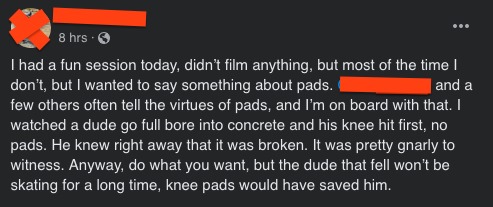
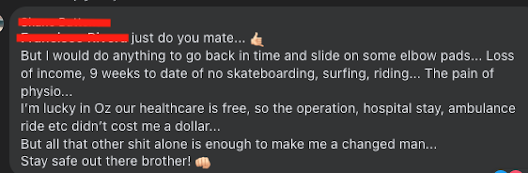
First, I want to start with these two screen grabs from Facebook.


I am not trying to scare anyone with this, but I am trying to give you a reality check. Keep this poor guy's experience in mind as you read the next section. He may have something to teach us.
Reaction time is slower with age. A hard fact of life is that our older-selves simply cannot move as fast as our younger-versions. Gravity, however, remains unaffected by our age. This means some things will be a lot harder to do (e.g. there is a real reason why older skaters often have trouble with flip tricks, and/or why people in their 40s people don't run marathons as fast as people in their 20s, etc. Again, hard fact of life and biology.). Additionally, we are not able to react as quickly to tricks that have gone wrong as we once did. This is an important consideration, because the inability to react fast enough can lead to some nasty bails and, well, injury. More on this later on.
We are more susceptible to injury with age. This one is another hard fact of
time, life, and biology. We are more "fragile" now than when we were kids.
Bones become more brittle, and easier to break. Soft tissue is not as
pliable and flexible, making twists, tears, pulls, and strains much
easier and likely to occur.
You will get injured, and it takes longer to heal. Yet another hard fact of life and biology. It takes much longer to heal from injury when you are older (esp. the soft-tissue injuries). Avoiding injury today means skating (or going to work) tomorrow.
So, what are the best ways to approach and deal with all these considerations? The answers are below.
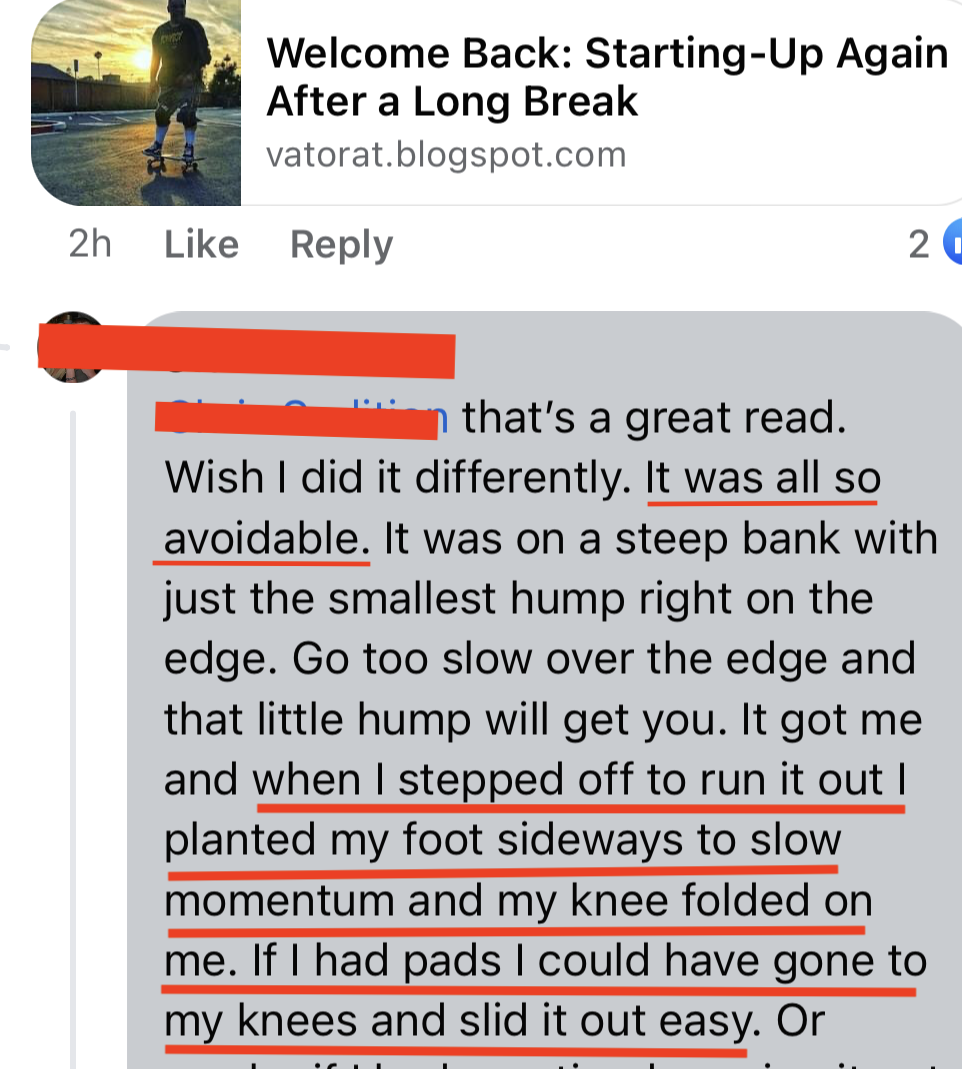
Start slow, and ease your way back in. I also can’t stress this one enough. I frequently hear about people injuring their Achilles and Patella tendons when first starting-up again (tendinitis, tears, Achilles ruptures, etc.) because they go too hard and too fast, before the body has had time to become reconditioned to the demands of skateboarding. Take this poor guy for example...

So, in order to help prevent this, do small, short, low-impact sessions when you first start again. Slowly work your way up to longer, more intense sessions. If you have been off the board for a really long time, start out by rolling around on a flat surface to get your balance back. Trust me, you will be surprised at just how much of it is gone (at least for the time-being). To be perfectly clear, if you have been off the board for awhile, even just pushing around a parking lot too hard/too fast could cause your Achilles (pushing foot) to have a little melt-down. Take it slow. Listen to what your body is telling you to do. And last, if you are much larger now than you used to be, don't worry about it. There are plenty of larger people who skate, and skate quite well.
Be extra careful on ramps. Skate parks, and thus ramps, are now everywhere. I have seen countless post on social media that follow this pattern: Person has not skated in a long time. Person starts skating again. Person starts hitting ramps/transition before they are really comfortable on the board. Person ends up with a broken bone in short time. Ramps are really, really, really something you need to ease your way back into. Make sure you are very comfortable just riding around again before you hit the ramps. Moreover, when you do start hitting them again, start out on the smaller ones and work your way up. Always remember that small ramps can still bite, and bite hard!
Start your sessions out slow, and end them slow. Warming up is critical when you are an older skater. Moreover, the time it actually takes to warm-up becomes longer and longer. Again, if you go too hard too fast you open doors to injury. Listen to what your body is telling you to do/not do. A long time ago I developed a specific “warm-up” routine (I have different ones for street/transition). Basically it’s a series of tricks that become progressively harder/more physically demanding. They are all still very easy, low-impact tricks, but they get the blood flowing, and the muscles/joints loosened up—which is exactly what you want to have happen. Injuries often happen at the start and end of a session. At the start, they happen because you're not warmed up yet. Towards the end, they happen because your muscles are tired and you get sloppy. Make sure you have increased situational awareness (of your body) during both of these periods, especially towards the end. Additionally, a slow end to a session helps your muscles "cool down" before coming to a complete stop (otherwise you'll stiffen up really quick). Ever notice that marathon runners just don't "sit down" as soon as the race is over? It's because they are "cooling down" to avoid muscle cramps. While it's to a much lesser degree, the same principle holds true with ending your skate session. Ease your way into and out of every session.
Stretch for flexibility. If your flexibility is compromised a simple bail, or even a run-out, can quickly turn into a twisted or torn muscle, ligament, joint, etc. The more flexible you are, the less chance there is of soft tissue damage. Soft-tissue injuries are among the most common injuries with the older crew (that’s us). Stretching on a regular basis can be a tremendous help to minimize these from occurring. I often see people “stretch” for 30-60 seconds before a session. This is not stretching. This is polishing brass on the Titanic, for the first time, after the ship has already broken into two peices. Like going to the gym, to get any real benefits from stretching it has to be something you do on a regular basis, not just for 45-seconds before a session. Consider this post on Facebook as an example.

Now, no one is expecting any of us to do full-splits--that's just not realistic. But, if you have greater flexibility in your groin, hamstrings (or any other muscle for that matter), bails like this might not produce injuries that are as acute or damaging. Simply put, stretching can turn what might have been a catastrophic injury into a far less serious one. The body is like a bridge, if all the little supports are stronger, the whole structure is stronger, too. There are plenty of simple and easy ways to incorporate stretching into daily life (Google will show you how). This Instagram account, run by Dr. Kyle Brown, features some great stretching and training exercises designed specifically for skateboarders. It's absolutely worth a look/follow.
Your feet will hurt for a while. There are so many small muscles in your feet/body that support the larger ones. They have “atrophied” over time, and are not use to the rumbling and quick movements involved with skating. It will take awhile for them get used to it again. Seriously consider different shoe options (more on this in the equipment section).
Once you start, don’t stop. Once you get up and running again, skate as much as you can. Like stated above, skateboarding is like a lot like going to the gym. If you only go once every 14 days, you will not see any retained benefit. You will have to relearn the same tricks every time you skate, and you will be really sore after each and every session. Worse, you leave yourself open to injury because you never really become “conditioned” again. There is real truth in the phrase ”use it or lose it.” You will be surprised at how fast you loose something (e.g. balance and tricks) by taking time off the board. The more you skate, the easier it becomes. But also, don't over do it, either! Taking a few days off here and there can really help rejuvenate both the mind and body.
“Getting your legs back” and cross-training. When you get back on the board, your legs will feel like a gelatinous mass of non-responsive, unstable, and uncontrollable muscle tissue. One of the most common questions returning skaters have is, “How do I get my legs back?” The short answer is keep skating, on a regular basis, and they will come back. It will take awhile. Cross-training with other stuff will help (riding a bike, squats, etc.). But much of it does not replicate the jumping, crashing, and sudden jarring of body like skating does. Jumping rope, box jumping, and running can all be huge assets in this department. That said, remember two things; Take it slow in the beginning, and once you start, do not stop. Slow and steady wins the race.
NO CORRECT ANSWER
Everything above is hard fact. Reaction time decreases with age. Healing time is slower with age. Stretching will help minimize injury. Go too hard, too fast, and you’ll get hurt. Falling is part of skateboarding. These are undeniable, irrefutable facts. Now, we are moving into a gray area, and covering something a little more subjective: Pads. You may have balked at pads in the past, but keep reading. You may start to realize things that were not even on your radar before you started reading this very post. Pads fall into the realm of personal cost/benefit analysis, and what risk factor(s) you are willing to assume. There is no correct, or even fact-based, answer. The only answer is the one that makes the most sense for you. That said, here are few things to consider.
Mini Ramps, Embankments, Bowls, Etc.: If you’re going anywhere near mini ramps, bowls, quarter pipes, or even embankments seriously consider pads (and a quality set). Remember what I said above about not being able to react as quickly to tricks gone wrong? Well, when your reflexes, balance, core strength, and flexibility are not what they used to be, when your brain remembers things that your body just can’t do as well anymore (and you don’t heal as fast), pads can be the only thing that saves your ass.
If you are skating any inclined surface, knee sliding out of a bail (that you could otherwise easily run-out of) can help avoid twisted ankles and knees. This is not to say you should knee-slide out of every bail--you simply shouldn't. However, run-outs gone wrong can end horrifically. Knee-slides take the potential injury of a sketchy run-out off the table. This guy learned the hard way.
Knee-slides also saves energy and can put less impact on joints. For example, if I run out of a lot of tricks on 5’ mini, my knees hurt at the end of the session (from all the jarring/jamming motion of running down the tranny). If I wear pads, and knee slide instead, I have no knee pain later on. Moreover, pads can give a confidence boost, and help remove some the hesitation and fear that absolutely becomes more acute with age.
Personally, I won’t go near any ramp 4-feet tall (or over) without knee/elbow pads anymore. I cannot begin to count the number of times that they have saved my ass from some really serious injuries, as can be seen here. That link is absolutely worth reading, because it shows how pads can indirectly save other parts of your body. Never be fooled by the size of a ramp. Mini ramps can bite, and bite HARD (and again, healing is slower with age).
Here is one last screen grab from Facebook about knee pads:

Street Skating: If you are pure street skating, pads are not as “essential” as they are on transition. That said, contrary to what many claim, you actually can “knee slide” on street (Natas, and a 10-year-old, will show you how). I don’t wear knee pads on street (yet). I am sure it will eventually happen some day, but I always wear an elbow pad on my forward elbow, even if just skating a curb. Falling on your hands sucks, and can also lead to a sprained/broken wrist (remember, we break easier now). When I fall, I tuck my arm in, and let the elbow pad take the brunt of the impact. No cut hands, no wrist injuries, no swelbow (and to really drive the point home, everything takes longer to heal with age). A friend of mine, and good skater, shattered his elbow two weeks ago. Slipped out on something, and came straight down on his elbow. Surgery and lots of hardware. An elbow pad probably would have prevented that. Yeah, freak accident, but they absolutely happen. Again, there is no "correct" answer to anything pad related...just some things to think about and consider.
 |
| My friend's elbow, post surgery. |
Here is another one from Facebook about elbow pads.

Helmets: In recent years much new information has come out about concussions. I am sure you are aware of that material. If you want to go down a really grim rabbit hole, look up skateboarding and head injuries. You will see a lot of stories about people of all ages becoming incapacitated and/or having serious long-term injuries related to head/brain trauma. If you have a family to support, or a kid to set an example for, or any other considerations, a helmet might be something to think about. Again, there is no correct answer. Historically, I wore a helmet on ramps 5’ high or taller. It’s an arbitrary line, but that’s where I had drawn mine (probably because I hit my head on a 5’ mini without a helmet on, and then quickly learned to start wearing one). Some wear a helmet anytime they step on a skateboard. Others never wear one, on any sized terrain. It’s your call...but remember that image from Facebook above? Think hard about that one, esp. when you are first getting back on the board.
2020 Update: This video clip is my friend Chad.
Chad is a very good skater. He is doing a nollie bigspin to backside disaster in this clip, which is a trick he has on lock. But some times things go wrong, as they did here. Imagine this slam without a helmet. Head trauma is one of those things like cancer or a bad car accident--they don't seem "real" until they happen to you or someone you know. I saw my friend Chad take this gnarly head hit. It became real for me. I am now wearing a helmet even on 4' ramps.
Here is one last clip. This one is me. I made a little railside bar that fits exactly in the back of my car. Before I went to skate that night, I had a common mental debate with myself, "It's just a mellow street session, do I really need pads?" I decided to bring them (I'm still recovering from that broken leg injury mentioned above). Well, check out my switch stance frontside railslide to fakie in that video clip. Watch my left arm/elbow...I am pretty sure I would have shattered my elbow cap without an elbow pad. Turn the sound up, and hear just how hard that hit. The point of my clip? To illuminate the fact that you do NOT need to be skating "hard" to get seriously injured, or to reap the benefits of pads. Thank fuckin' god I had that thing on.
To clarify, I am NOT trying to scare anyone out of skateboarding. I am NOT saying you need to be decked out like a hockey player every time you step on your board. I am just trying to make everyone aware of risks they may not have been fully cognizant of...because those risks ARE very different and more pressing later in life than when we were kids. As I was making a few 2020 updates to this post, I saw that an older guy I follow on Instagram just fractured his knee cap (no pads). He elucidated the "different risks" concept quite well, with a very poignant comment, "Should have seen this coming. 30 years of skating and never broke a bone, didn't think I skated 'hard enough' (to need pads), but I broke it doing something I thought I had in the bag. Guess it's full pad street shuffle for me now. Time to slow my roll." But to that end, there is no correct answer on anything safety gear related. The only answer that counts is the one that keeps you rolling, and the one that makes the most sense for you. However, I will suggest that you give pads serious consideration when first getting back on the board. "The beauty of (knee) pads is that, even after you've committed to landing a trick, if you notice something doesn't look/feel right, the option to bail to your knees is always present. However, if you are padless, there is a definitive point where once you have decided to commit, and you notice something is off/wrong after that point, you are in for some shit. Pads give you more options." (not sure who said this, but it's so on-point). That's a good thing, especially when you are first getting back on the board and, finding your balance again. Again, don't take my word for it, take the advice of the (countless) people who have been in the exact same position you now find yourself in.

HAPPY & HEALTHY ROLLING
In closing, you will get injured skateboarding. Healing is slower with age. Yeah, it sucks, but that is our reality. As a result, really consider everything above about injury prevention (e.g. taking it slow, stretching, warm-ups, pads, etc.), and make decisions that are right for you. And remember, if you have no expectations about what you should be able to do, skateboarding will flourish like never before, and you will have more fun on your board than you can possibly imagine. Happy and healthy rolling!
I'll end with this quote from Bernie O'dowd, "There are infinite ways to have fun on a skateboard. But, it is inherently dangerous. Especially for an older person. We are slower, weaker, heavier, less flexible and as a result of all of this often more fearful. It's OK. I think it's just important to be aware of this. Get comfortable, and confident. Then you can find your limits, and push them without immediately getting hurt."
[In the next section, which can be found here, we dive into equipment. This is the best time in history for skateboard gear. You can get literally get anything you want. An early 1980s reissue, an early ‘90s football shape, a popsicle, or a modern shaped board. Whatever you want to ride, it’s out there. Wheels don’t really get flat-spots anymore. Bearings are better than ever before. Shoe technology has advanced a lot, and that can be a huge help for old-guy knees. You will be more stoked on your set-up than at any point in your life.]
Wednesday, November 20, 2019
2019, The Year Things Changed
Kind of at a loss for words. Skateboarding is the most important thing in my life, usually. Then something real happens.
Parents’ had their dog put down on Nov 15th. I was there when it happened. Thought about the passing of Edward Pidgeon not long ago. A friend’s sister committed suicide last month. Two days ago I got word another friends’ mother had passed after a long illness. “I was with her, holding her hand and talking to her as she passed,” he wrote. I was at work when I saw those words. I went into the bathroom and cried for a bit—out of both sadness for him, but also out of a deep existential appreciation for how profound, beautiful, and meaningful the scene was that those words painted. Of course, all of this has made me (again) think about my own parents’ mortality.
Thanksgiving is next week. For several years now, every time a holiday, birthday, or some other special occasion rolls around I always think, “Is this the last one that we will all be together for?” That perspective is both a blessing and a curse. In either assessment, it really forces you to sap every last bit of meaning out what time there is. To some extent, without finality everything might become meaningless. That our time is limited is what really allows it to…flourish.
I have reached the point in life where I will be attending more funerals than weddings. I have reached the point in life where, at 12:30am in the morning, I am not out at a bar, or skateboarding, but sitting home alone writing about death (and thus life).
2019 has taken me down a notch. Only one other year has provided me such “opportunity for growth,” as the optimists like to say. Between my own injuries, my parents’ age/health issues, and what has happened to those around me, much has changed this year, and not for the better. I leave 2019 a very different person than I entered it. Many do.
On Dec 20th 2019, I am having another surgery on my ankle. They are going to remove a large screw in my leg, and potentially scrape away some internal scar tissue, which may be preventing flexibility and movement. I really hope this improves things. For walking. For hockey. For skateboarding. Five days later I’ll be spending Christmas with my elderly parents.
Flexibility. Movement. Hope. Improvement. Family. I can’t think of a better way to end this year. Whomever may be reading this, you have my best wishes for 2020.
Parents’ had their dog put down on Nov 15th. I was there when it happened. Thought about the passing of Edward Pidgeon not long ago. A friend’s sister committed suicide last month. Two days ago I got word another friends’ mother had passed after a long illness. “I was with her, holding her hand and talking to her as she passed,” he wrote. I was at work when I saw those words. I went into the bathroom and cried for a bit—out of both sadness for him, but also out of a deep existential appreciation for how profound, beautiful, and meaningful the scene was that those words painted. Of course, all of this has made me (again) think about my own parents’ mortality.
Thanksgiving is next week. For several years now, every time a holiday, birthday, or some other special occasion rolls around I always think, “Is this the last one that we will all be together for?” That perspective is both a blessing and a curse. In either assessment, it really forces you to sap every last bit of meaning out what time there is. To some extent, without finality everything might become meaningless. That our time is limited is what really allows it to…flourish.
I have reached the point in life where I will be attending more funerals than weddings. I have reached the point in life where, at 12:30am in the morning, I am not out at a bar, or skateboarding, but sitting home alone writing about death (and thus life).
2019 has taken me down a notch. Only one other year has provided me such “opportunity for growth,” as the optimists like to say. Between my own injuries, my parents’ age/health issues, and what has happened to those around me, much has changed this year, and not for the better. I leave 2019 a very different person than I entered it. Many do.
On Dec 20th 2019, I am having another surgery on my ankle. They are going to remove a large screw in my leg, and potentially scrape away some internal scar tissue, which may be preventing flexibility and movement. I really hope this improves things. For walking. For hockey. For skateboarding. Five days later I’ll be spending Christmas with my elderly parents.
Flexibility. Movement. Hope. Improvement. Family. I can’t think of a better way to end this year. Whomever may be reading this, you have my best wishes for 2020.
Tuesday, October 29, 2019
Diesel Jeans, Gucci Bag, Waxed Eyebrows (and a Thrasher shirt)
I was in line at a café. A mundane afternoon. Then I noticed the guy in front of me. Introspection followed.
He was wearing shinny, opulent shoes. Diesel jeans. A black Gucci bag dangled from his bent wrist, which was adorned with several loose fitting gold and silver bracelets. Obviously gay. He had short, neatly trimmed facial hair, vaguely resembling George Michael. Freshly waxed eyebrows. A few streaks of platinum-blonde were dyed into his otherwise dark locks, which were slicked back. A ghastly toxic cloud of too much cologne hung in a 3’ fallout radius around him. He was wearing a black sweatshirt that was torn around the head opening, in some garish type of Vogue/GQ sanctioned manner. More gaudy, loose fitting gold jewelry hung around his neck. The logo on the sweatshirt? “Thrasher Magazine.”
I wanted to talk to him. Not to be an asshole, but because I was genuinely curious. I wanted to ask him why he chose to wear that sweatshirt. I wanted to know what it meant to him. I wanted to ask him if he’s ever picked-up a single issue of Thrasher magazine, or if he’s ever ridden a skateboard. I wanted to ask if he was willing to bleed, tear ligaments, shatter bones, and destroy parts of his body for something he loved. I’d like to ask what he thinks skateboarding means to skateboarders. I’d like to ask how he thinks people perceive him wearing that garment. I’d like to ask him if he cares about those perceptions. I’d also like him to know what it all means to me.
I’d like to show him my scars. Show him my inability to walk correctly, and how much trouble I have with stairs. Show him my x-rays, before and after surgery. Show him my deformed ankle. Show him the places my skin and blood has been left behind on rough asphalt. Show him the medical bills. Show him the tears when I realized it would be long time, if ever, before I could skate a 1/2-pipe again. Show him the nightmares that keep me awake at night when I think about life without skateboarding.
Of course, I did none of things. Nor would I ever. Calling-out some random stranger is more obnoxious and pretentious than wearing a Thrasher shirt when you can’t even name a single pro skateboarder. Instead, I thought of the irony. He had no idea who he was standing next to. In fact, neither did I. I was acutely aware that this entire situation revealed far more about the content of my own consciousness than it did about anyone around me, including him.
Skateboarding has changed. Perception of skateboarding has changed. We used to get beaten-up, shunned, and ostracized for skateboarding. Now we are fashion icons, and profit demographics for multinational corporations. No news there. I can’t change any of that. I’m not sure I’d even want to.
That said, it always stirs deep emotion when something I have dedicated my life to, and destroyed my body for, is reduced to mere “fashion accessory” for those who have never known the same passion. I would never wear something just because it “looks cool” without some sort of horse in that race. I am forever bewildered by those can.
To be clear, there is no point, moral, or social edict to this story. Do not look for one. I am simply sharing an experience I had at a café.
He was wearing shinny, opulent shoes. Diesel jeans. A black Gucci bag dangled from his bent wrist, which was adorned with several loose fitting gold and silver bracelets. Obviously gay. He had short, neatly trimmed facial hair, vaguely resembling George Michael. Freshly waxed eyebrows. A few streaks of platinum-blonde were dyed into his otherwise dark locks, which were slicked back. A ghastly toxic cloud of too much cologne hung in a 3’ fallout radius around him. He was wearing a black sweatshirt that was torn around the head opening, in some garish type of Vogue/GQ sanctioned manner. More gaudy, loose fitting gold jewelry hung around his neck. The logo on the sweatshirt? “Thrasher Magazine.”
I wanted to talk to him. Not to be an asshole, but because I was genuinely curious. I wanted to ask him why he chose to wear that sweatshirt. I wanted to know what it meant to him. I wanted to ask him if he’s ever picked-up a single issue of Thrasher magazine, or if he’s ever ridden a skateboard. I wanted to ask if he was willing to bleed, tear ligaments, shatter bones, and destroy parts of his body for something he loved. I’d like to ask what he thinks skateboarding means to skateboarders. I’d like to ask how he thinks people perceive him wearing that garment. I’d like to ask him if he cares about those perceptions. I’d also like him to know what it all means to me.
I’d like to show him my scars. Show him my inability to walk correctly, and how much trouble I have with stairs. Show him my x-rays, before and after surgery. Show him my deformed ankle. Show him the places my skin and blood has been left behind on rough asphalt. Show him the medical bills. Show him the tears when I realized it would be long time, if ever, before I could skate a 1/2-pipe again. Show him the nightmares that keep me awake at night when I think about life without skateboarding.
Of course, I did none of things. Nor would I ever. Calling-out some random stranger is more obnoxious and pretentious than wearing a Thrasher shirt when you can’t even name a single pro skateboarder. Instead, I thought of the irony. He had no idea who he was standing next to. In fact, neither did I. I was acutely aware that this entire situation revealed far more about the content of my own consciousness than it did about anyone around me, including him.
Skateboarding has changed. Perception of skateboarding has changed. We used to get beaten-up, shunned, and ostracized for skateboarding. Now we are fashion icons, and profit demographics for multinational corporations. No news there. I can’t change any of that. I’m not sure I’d even want to.
That said, it always stirs deep emotion when something I have dedicated my life to, and destroyed my body for, is reduced to mere “fashion accessory” for those who have never known the same passion. I would never wear something just because it “looks cool” without some sort of horse in that race. I am forever bewildered by those can.
To be clear, there is no point, moral, or social edict to this story. Do not look for one. I am simply sharing an experience I had at a café.
Subscribe to:
Posts (Atom)