Saturday, November 13, 2021

Random Updates on Saturday Afternoon

I’ve been posting a lot of reviews on this blog. While I admit they can be helpful to people, it was not something I ever intended to do with this blog. The intention was to keep more towards the daily life-existential-philosophical implications and aspects of skateboarding. It seems I have drifted somewhat from that. I suppose that is as much an existential reality as any.

In any event, here are some random updates from life in mid November 2021.

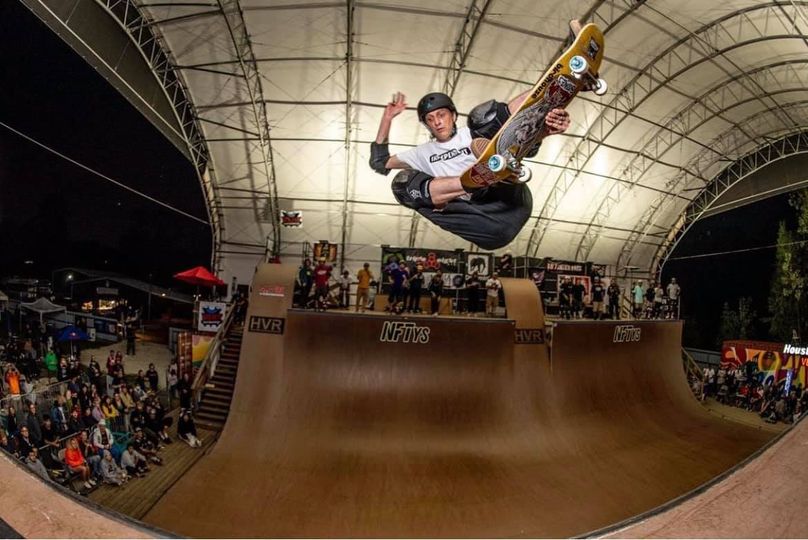
(1)    My friend Joe got shoot (photos) of Tony Hawk, Bucky, Staab, Rene, and other big hitters in Texas last night. That is so awesome. Here is a pic he took of Hawk and Staab.


(2)    Staab has always been off in his own world. I am glad to see that has not changed with time. That is an inspiration as much as his skating is.

(3)    I am out on injury, again. Happens a lot these days (hi, old age). This time it’s a pulled muscle in my lower back. I did it on November 9th. I landed an (early grab) b/s air on a mini ramp, and when I landed, my back was like, “Ok. You’re done.” A similar thing happened (other side) when landing an Indy nosepick off a bench earlier this year. It appears that a “hard” landing, while bent over, is something that causes this. I wasn’t really warmed up on either of these two days. Now that it happened a second time, I’m starting to learn/see the patterns. The take away is to, (a) make sure I am really warmed up before going too hard, (b) stretch more in daily life, and (c) maybe add some strength training? It’s starting to feel a bit better. I hope top be back on the board in another week or so.

(4)    I’ve been on this weird trip recently—I need to write more about this, actually—at first I thought it was a nostalgia thing (maybe it is??), but now I seem to be viewing more as an experiment in personal archeology. What does that mean? I means I am toying around with what I experience in the present when I do, visit, and rehash some of the things I did when I was much younger. I am not trying to relive anything from the past. Rather, I am curious about the present, and what happens when the experience of time and place fold back onto each other, if that makes any sense. Again, I need to write more about this.

(5)    My 1980s Instagram account now has almost 18K followers. That is insane. I never thought more than 50 people would be interested that feed. Much of what I was talking about in (4) above has been triggered by some photos from that feed. Again, I need to write more about it elsewhere.

(6)    Fall is here. My favorite time of year to skate. It’s been really warm so far (well, climate change and all that), so it hasn’t really felt like a typical “cool” fall. Winter will be here soon enough, so I shouldn’t complain.
 

Thursday, August 26, 2021

The Big Four: Ace vs. Indy vs. Thunder vs. Venture

 I recently revisited the four major trucks brands. 
 
Ace. 
Indy.
Thunder.
Venture.

Below is a ultra stripped-down product review/comparison of each. But don't take my opinion as dogma. Try them and find out what works best for you.


Ace 44 AF1 (8.25")
 
"Squirrel Tanks." These are heavier than standard Indys. I could not get passed this. I constantly noticed it. The stock bushing are mush. Combine that with Ace's shorter wheelbase, and these things ride like "squirrel tanks." Due to non-standard sizing of Ace bushing, there is no easy swap-out for aftermarket bushings.* Some fawn over how Ace trucks looks. I am not one of them. I think they look like something you'd get on a Wal-Mart board. Oh, the sound. How could I forget that? Something about these trucks (the pre-oiled pivot cups??) made my board sound like it was just pulled out of a swamp--a horrific water-logged, deaden, thud. I can't deal with that. Oh, they are really expensive, too. And I'm not even going to touch on the fiasco with with their sizing catastrophe. Different is one thing. Dumb is another. Lot of the latter going on over there. All this said, Ace trucks do turn really well, and have a nice surfy feeling. I can see why people like them. I, however, am not one of them. I should also note that since they have the shortest wheelbase of the group, they have the "worst" pinch (e.g. krooked grinds).
 
Heavy.
Squirrel turn.
Ugly.
Sound like Swamp Monster.
Over-priced.
A lesser pinch.
 
*Ace now makes a "hard" aftermarket bushing if you want your trucks a bit tigher....but they still ride quite loose. 
 
Thunder 148 Team Hollows (8.25")

I didn't totally hate these. Wait. Yes, I did (but not as much as Ace). They are tad lower than my Indys, and have almost the exact same wheelbase. The turn, however, is very different. It's a much stiffer turn (at first), but then goes kind of quick at the end, and then snaps back to level. Even with softer bushing my trucks felt "tight." I found myself doing lots of tick-tacks. No fun. I tried a few different bushings types and hardnesses in these. Nothing felt really good. They had a decent grind. The slightly lower truck height made my pop feel a little more...flat. These might be better suited for a deck with steep kicks, but I am not about to switch out trucks based on the deck I am riding. The real deal-breaker on these is the baseplate issue. Even if you were to assume that I could make these turn/pop like my Indys, I'll never get passed the Thunder baseplate problem. Yeah, you can nose/tail slide on Thunders. That said, there is less room for margin of error and/or you need a lot more wax, and it becomes a lot more like a power slide (e.g. wheels rubbing) than a nose/tail slide. Hard pass for me. Thunders, however, have some of the best pinch on the market.
 
Souless turn.
Wonky pop.
Absurd baseplate.
Killer pinch. 
 
Venture Hollows 5.6 (8.25")
 
The lightest of the bunch (but only by a tad). Oddly, I liked these more than Thunders, despite Ventures also having the longest (by far) wheelbase of the group. I put stock 90a Indy bushing in these, and they felt...meh. Certainly not a super-quick turn, but a turn that felt decent. Venture are notorious for a stiff "turn." Weird grind. Metal seems harder than any of the others. Ace, Thunder, and Indy all have a round metal encasing around the axle. Venture does not. Theirs is more of a "straight wall" of hanger. I feel like the rounded axle encasing of the others helps with grinds, whereas the "wall" of Ventures has a tendency to catch more (esp. on chunky ledges/curbs). Best kingpin clearance of the bunch for Feeble/Smith grinds. I also think these trucks look a little...weird, almost 1960s SciFi-ish (which is normally a great look). And again, weird baseplate issues. There are two problems with Venture baseplates. First, is the outermost hardware mounting holes are so far under the hanger (or the hanger is so far out over the baseplate) that it makes its really difficult to get a skate tool on the mounting hardware bolts. This is just absurd. Second, is the exact opposite problem of Thunders; Venture baseplates stick quite far out*--more so than any other truck on the market. Thus, the extended baseplate gives you a smaller effective nose/tail (e.g. less space to balance on). I mean, we are talking small amounts here, but it's enough that (a) I can notice it, and (b) it occupies space/causes mental doubt in my head about nose/tail slides. Last, Ventures with their long wheelbase also have great pinch.
 
Weird grinds.
Meh turn.
Meh-er looks.
Baseplate calamities.
Good pinch.
 
*NOTE: The forged Venture baseplates are the ones that stick out kind of far. The cast/regular baseplates are about the same size as Ace/Indy (e.g. normal). Also, the forged plate Ventures have a longer wheel base (.25" longer) than the cast plate Ventures. There is also a height difference between the two. I think forged was around 52mm and cast was around 54/55mm. 
 
Indy Titanium (or any forged Indy) 144 (8.25")
 
I saved the best for last. No baseplate issues. Not too heavy, not too light (these are actually a few grams lighter than the Thunder Team Hollows). Smooth consistent turn (with lots of aftermarket bushings to get exact turn feel you want--super loose, to super tight). Mid-sized wheelbase. Mid-sized height. Every truck listed above has some kind of "problem" with it (weight, turn, grind, baseplate, appearance, etc.). Indy has none of those, at least for me. Everything else always gets compared to Indys, for a reason. A friend said it best, "If you are trying to get your trucks to ride like Indys, then just ride Indys." Pinch is better than Ace, but not as good as Thunder/Venture.
 
Note: Forged Indys are 53.5mm tall. Standard Indys are 55mm tall. Standards are too tall for me, and get a little ghost-pop at times. The forged ones are a great mid-level height, on par with most other trucks. The mid-Indys (mIndys) are 52mm tall, but those things have a host of other problems I'm not getting into here.        


Wednesday, February 17, 2021

Ankle Update, Feb 2021


This below clip is a little outtake from last night's session. The angle iron was a tad sticky. Didn’t go fast enough/lean back far enough to compensate. Front end dipped down. I stepped-off onto the bad ankle...and down I go.


Almost two years after the initial broken bone, after two surgeries, after almost a year back on the board, and after significant recovery, my front ankle STILL betrays me on occasions...and sometimes even on very simple/low impact things such as this little 5-0 grind. I never know when it’s going to happen. 


Fortunately, this doesn’t occur nearly as often as before, and when it does, my ankle doesn’t hurt nearly as bad. Things like this used to be a session-ender. Now I just get up and keep going. That’s awesome. The pads continue to be a real life-saver when it does happen, because I usually go down straight to my knee (sound on to hear the plastic scrape). I don’t foresee loosing those anytime in the near future—it’s just not a game of Russian roulette I want to play with my kneecaps, because eventually I will loose in a serious way. It's just not worth it. 


The other major improvement is that I can now control my falls much better than before—I don’t go down nearly as hard. That’s also great news. So, despite occasional floundering, my ankle doing pretty good. 


Keep pushing...I certainly am. 

Tuesday, February 2, 2021

Diminish, Fade, and Wither: The Inspiring Delcline of Tony Hawk

I am an old, broken, skateboarder. My balance is not what it once was. I don’t react as fast as I used to. I don’t heal as quickly as before. Every year skateboarding becomes harder. Every year I become more susceptible to injury. I like my pads a hell of a lot more than I used to. These are hard facts of biology, time, age, and life.

Recently Tony Hawk posted about his recent struggles doing a 720. A trick he invented long ago. He said he could not spin them as fast anymore. He said previous attempts ended badly and did not inspire confidence. He said they were much harder now. He battled it for awhile, pulled one, and said he may never do it again. Albeit vastly different scales, these battles are ones many of us already know quite well. I certainly do. They are also battles EVERY skateboarder WILL know, provided they stick with it long enough. There is no escape.

It’s not often someone in skateboarding, especially someone at Hawk’s level, openly talks about (and shows) the impact of aging. It’s almost unimaginable to hear TONY HAWK talk about battles with CONFIDENCE. Hearing and seeing his own battles with declining skill and ability certainly make our own battles with the same that much more universal and...humanizing.

Much respect for making that 720, Tony. But even more respect for the honest vulnerability. Every session is a gift. It won’t last forever...and even Tony Hawk knows that.

We diminish. We fade. We wither. And that, at least to me, is a gift. The impermanence of it all is what makes it so special. It’s what makes it so hard to take anything for granted, and what reveals how profound the simple really is (and I’m not talking about just skateboarding here). As I knowingly roll into my own twilight, I do so with a gratitude brighter than a thousand Suns.

Hawk, battling to land a 720, one last time.


Saturday, January 30, 2021

Well, My Arm Isn't Broken...(2021 is off and running)


Well, 2021 is off to an interesting start. On Jan 4th I badly hyper extended my elbow. I gave it a few days to see how it was doing, but started to think it might be broken???? However, I had to hold off on going to the doctors. Why? Well, I got Covid. Fortunately it was not a very bad case. That said, almost three weeks after the first Covid symptoms appeared, I still have ZERO taste or smell.

Once out of quarantine I was able to see the doctor about my elbow. X-Ray showed no break. That is good, but almost a month later it still hurts in some situations. The Dr. said to come back in 2-3 weeks if it’s still causing some problems. I have a feeling it will be.

Just as I was again feeling almost 100% post-Covid (aside from no taste/smell), and ready to do some mellow skating again (with an elbow pad on bad arm), the weather took a turn for the worst. We are in the middle of a bad cold snap right now. It is currently 10 degrees outside. Wind-chill is well below zero. The cold is supposed to end in two days, to be immediately followed by a large snowstorm. By the time I am back on the board it will be over a month since I last skated (and will probably still have the elbow injury when I start rolling again). That sucks.

Tuesday, January 5, 2021

Big Wheels Might be a Big Problem (or Don't Let the Past Ruin Your Present)

Often people who cling to sentimental notions of the past do not realize how much their set-up is actually holding them back (especially when deck/truck/wheel ratios are WAY off). This is not only true for those wrapped up in nostalgia, but those who may not be aware about the so-called "proper" ratios of a modern skateboard. I say it all the time, but equipment evolved FOR A REASON. Below is a post someone made on Facebook after they had serious equipment epiphany. I am not, by any means, saying there is a "correct" way to set-up your skateboard. There simply isn't. That said, there are consequences to the way your board is configured. Some may not be fully aware of those consequences. Thus, I am ONLY trying to share information, which may make for happier skateboarding. 

__________________

“Since returning to skating after several years off, I have been focused on getting back
everything I used to be able to do, within reason (which was not much to begin with). I then hit a plateau, and stopped progressing. Most of it was admittedly out of fear of getting hurt, but the rest was centered around never feeling stable and balanced on my board. I always felt like I was going to tip over and fall off. I couldn't get my wheels over the coping to grind because I felt like I was going to fall off. I couldn't roll-in because I always felt like I was going to fall off. I couldn't ollie because I would actually fall off every time I bent my knees.

It was miserable. I went skating every day this week. Each time, instead of feeling better afterwards like skating always does to me, I felt increasingly depressed. When I got home from the park yesterday, I was pretty much disgusted with myself. I made a sandwich, cracked open a beer, put on some sweats, and sat in my recliner, moping over the fact that I am a washed-up has-been, and generally being whiney. I was blaming it on my weight, my age, my joints, etc.

Then as I was watching a show on TV, something was mentioned about fulcrums, levers, and pivot points, and, my brain exploded...my board is too tall.

I am constantly analyzing, engineering, and tweaking things to make them work better in pretty much all aspects of my life. In skating, I am always trying new equipment and changing combinations, to find that optimum configuration.* A lot of times it is just me doing retail therapy to compensate for sucking, but sometimes I find something useful.

I love innovation, but sometimes I get stuck in the Old Man mindset where I have false assumptions that everything from “my time” was better. I realized that while I have a modern board, my configuration was completely stuck in the 1980s; my wheels, trucks, and boards...all huge.

There was a logic behind it: Tall wheels go faster and are easier to get over coping, sidewalk cracks, rocks, and other obstacles. Wider wheels have more surface area. Wider trucks and boards offer a more stable platform and turn easier. But there is a tradeoff. All of that big tall Monster Truck mentality has side effects. Besides the instability just rolling, I was having muscle injuries in my pushing leg, because I couldn't get that foot to make solid contact with the ground. I was hitting every push with the toes, and that was causing a chain reaction strain from my Achilles to my thigh.

So, today I went to my local skate shop, and bought a new set of wheels; the smallest wheels I have ever owned. I drove to the skate park, broke out the tools, and stripped my board down. I took my riser pads off, and switched my wheels from 60mm to 54mm.

I hopped on my board to take a test run, and it was literally night and day. I instantly felt completely stable and in complete control of my board. Instead of constantly feeling like I was falling off, I felt like it was glued to my feet. I was instantly going 2x faster, doing ollies, grinding, and generally just playing catch-up for the last two months.

The Lesson: I was completely stuck buying top of the line stuff, but always top of the line Retro Reissue stuff. I kept subconsciously equating anything “smaller wheels” with the early 90s "bearing cover" wheels. I knew there was a difference those and modern “small” wheels (e.g. under 60mm), but I just couldn't get it through my head that I can still skate AND use modern equipment, let alone that I would actually be able to skate better. So, don't let yourself get stuck in a rut because you have "always done it this way." You might only be diminishing your own ability.”

*Be careful falling too far down this rabbit hole. Yes, an 8.75” deck with Indy 159s and 56mm wheels is going to ride VERY different than an 8.0” deck with titanium Thunder 147s and 50mm wheels. Getting into extremely minor equipment tweaks (e.g. 52mm vs. 53mm tall trucks) will often lead you to an OCD-induced madness without any real substantive performance benefits.


Saturday, December 19, 2020

Popsicles v. Shaped-Decks

 
This article was written by someone who religiously rode shaped boards, and then decided to give popsicles a try. His analysis is below. It is worth a read.


[I did not write this article, Kyle DuVall did. I wanted to link his blog post to someone on Facebook, but it seems something has gone askew with the Blogger formatting on Kyle's post (I see white typeface on a white background when I view it). Hence, I copied and pasted the text here for easy reading.]

The Popsicle Experiment
December 7, 2015
By Kyle DuVall


For the last two years I have been one of the thousands of skaters who has embraced alternate skate deck shapes. I've ridden shovel heads, punk points, curvaceous, wide bodied hybrids like the Street Plant Street axe, and I’ve had custom shapes made to my own specs, The whole time I've been pretty vocal about how these shapes can be more than just nostalgic, stylistic affectations.

About 3 months ago, for the first time in 2 years, I set up my first popsicle deck. It was my attempt to come full circle with all my experimentations, and see how my perceived preferences stood up against the baseline of modern skateboarding.

Even in light of all of my shape advocacy, I would be lying if I said that I didn’t notice immediate advantages with the popsicle. There are good reasons to ride a standard shape, just as there are good reasons to ride a well-designed alternate shape. Teasing out what advantages come from the actual popsicle shape and which come from other factors like a shift in wheelbase size and width is a more subtle matter.

For my return to the standard shape, I doubled down and went with a Chinese-produced, mass manufactured deck: an Almost Chris Haslam resin 7 model with a 8.38” width with a 14.25” wheelbase. I picked Almost because a friend of mine, who has a tendency to snap decks as if they were the proverbial popsicles of the shape’s name, has been extremely lucky with their wood, and the dimensions and slightly blunter contours on Haslam’s model seemed ideal.

At the heart of my popsicle experience was a healthy drop in the length of the wheelbase I was riding.

A number of designers, brands and retailers have created their own recommendations for matching wheelbase sizes with riders, recommendations I have, in true skate anarchist fashion, usually ignored (I’M NOT GONNA LET THE MAN TELL ME WHAT WHEELBASE I SHOULD RIDE!!). I have been riding 14.75” to 15’ wheelbases for the last couple of years. The Haslam’s 14.25 wheelbase size actually lines up with the wheelbase I am ‘supposed” to be riding according to most of these recommendations.

Knocking half an inch off the WB changed the whole dynamic of how my front foot slid and how my back leg compressed in an ollie. When I ollied the Haslam, the tail of the board sucked right up against my feet as my rear knees bent, giving a very controlled, very level and snappy ollie. This effect improved my ollie even more once I altered my front foot slide to actually scrape beyond the front bolts and partially into the nose, a technique a lot of guys who learned to ollie on the tiny-nosed decks of the 80s, have neglected to learn. All in all, the shorter wheelbase (in combination with a shorter and more rounded tail, more on that later) had me popping ollies higher, in a shorter arc. The advantage on ledges and in popping off skatepark banks was dramatic.

Of course, you could put a short wheelbase on a shaped deck and gain some of these advantages, but very few brands offer shapes in the smaller wheelbases. Finding a stock 14.25” shaped deck is almost impossible and 14.5” is very rare. If there is one thing I have learned from my switch up it is that a lot of guys who love riding the shapes may be ill-served by the long wheelbases that come with them, especially if they are street skating. Brands might do well to branch out with their shaped deck designs.

The shape and the dimensions of my popsicle’s tail also played a role in that new snappier pop. The Almost Haslam had a 6.5” inch tail with the standard rounded shape. I’ve been riding 6.75 and 7 tails. The shorter tail definitely let me channel more power straight down much easier, this combined with the short wheelbase meant I could place my front foot farther up the board and still pop a good ollie. On a small wheelbase with a short tail, you can pop an ollie with the edge of your front foot practically touching the mounting bolts. This translates to much more stability setting up for a trick, and it makes it much easier to set up for the next ollie in a line. In a park setting it means there is a lot less sliding your foot around to adjust from pumping down a transition and popping an ollie on a pyramid or to a ledge. On the street course at the skatepark, the popsicle, or at least, the snappy tail and reduced wheelbase of that popsicle, was supreme.

The signature round shape of the tail can be a mixed blessing. The round tail design of the modern popsicle is designed for instability. Applying pressure to the rounded corners will essentially tip your board sideways, a motion at the heart of a lot of flip tricks. In fact, on the modern popsicle, the rotation of a kickflip or 360 flip comes just as much from the pressure of the back foot as it does the flick of the front foot. In the case of the modern 360 flip, the back foot “scoop” is often doing most of the real work. Once again, a lot of guys who struggled to nail kickflips and tre flips on the long-flat tailed decks of the late eighties find themselves stymied when it comes to getting the proper rotation on a popsicle. That's because, on those old tanks, the front foot was the engine that drove the flip. Apply the that technique to modern pop and chances are you will never get enough leverage in your pop to get off the ground, or at best, you will get a clumsily executed “rocket” flip. Kickflips on a popsicle are essentially a completely different trick than the flips we learned on fat boards in the 1980s.

Since the popsicle tail is basically built to tip, it means to get the most stability and pop on a plain old run of the mill ollie, foot placement on the tail must be more precise. If your foot is not well balanced and centered on the tail, the deck is going to pull sideways in one direction and tip a bit, meaning you will lose a lot of the power you are trying to put in your ollie and lose a lot of control as well. A flat, square-cornered tail shape, however, means you can apply pressure out of the “sweet spot” in the tail and still get a fairly solid, stable ollie.

Of course, even on a square tail you are going to pop better when you apply pressure to just the right spot in the center of the tail. One advantage of the rounded popsicle tail is that it essentially forces you to make sure you are always centered in your pop. It is a sort of conditioning tool in a way. You may start out less consistent on a popsicle tail, but the ollies you do will be cleaner and higher. The difference is a matter of consistency and on-demand stability versus versatility, improved vertical pop and the potential for cleaner flip tricks. There really is no “better” option. It's your call in accordance with your own style.

Another point of contention with modern decks is their durability. Veteran skaters often swear up and down that “they don’t make 'em like they used to” and single out Chinese production decks as especially suspect. On the whole, my Chinese popsicle took a pretty good beating and maintained a pretty good bit of elasticity and pop right up until the end. In terms of the longevity of aforementioned pop, the Almost Haslam certainly couldn’t compare with the eternal stiff snap of a workshop board like a Fickle deck, but it certainly stayed snappy up to the point where tail wear and other factors made a deck change necessary anyway.

The final verdict on this experiment: mixed.

I am definitely dropping my wheelbase from now on. Although the 14.25” size was definitely not optimal for bowl riding, splitting the difference and bumping up to a 14.5” wheelbase might work out well. A shorter tail than the 6.75” I have been riding is definitely better for me, although I’m thinking a squared 6.5” tail may be my best strategy. It's possible a square shape with a short length will mediate stability with the increased power the better leverage of the shortened tail gives me. The popsicle experience has certainly made me more wary of “punk point” noses. Nothing beats having a full sized nose, not just for nose slides and other ledge tricks, but also for ollies and, yes, even slappies. Cutting a 3rd of the real estate off your nose off just to get a “punk” look to your shape is not worth it. I’ll look more “punk” locking better backside slappies and more properly tweaked ollies. I think the Grosso-style “shovel’ nose is the way to go for me.

The big take-away from it all: ride what you like, but don’t write anything off you haven’t tried in a while. “Just because everyone else does” is no reason to ride a standard shape. Then again, it's no reason NOT to ride one either.

[Now that you've read about modern technology with decks, here is another article about wheels and deck height!]